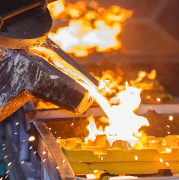
Today was my last day of research before I travel to Philadelphia for my work experience, so I spent today doing in-depth research on the process of making steel, specifically Carpenter’s manufacturing process.
The process begins with primary melting, which produces specialty alloys in powdered metal form to be further processed. Primary melting begins with an electric arc furnace, more often referred to as “EAF”. Electrodes are lowered into the furnace and are then hit with a high electric current, creating such a high temperature that the elements are melted down into molten and ready to be put into ingot molds.

The molten metal is then sent to the next step, Argon Oxygen Decarbonization or AOD where carbon is removed from the steel through oxidization; a mixture of argon and oxygen is blown through.

One of the last steps is then continuous casting where the molten steel or metal is solidified, yet still malleable (or hyphenate), into a billet, bloom, or slab. The rolling of this malleable metal will then be finished in the mills. This is the most common type of casting.

After speaking with a few employees at Carpenter about this process, I decided that there were a few key terms that would be beneficial to know prior to shadowing on-site, so I’ve included the terms and definitions below:
Cold Working: Any permanent deformation of unheated steel done by mechanical forces.
Lathe: Finishing unit that uses a carbide cutting tool to turn a finished surface on larger rounds.
Pickle: Chemical or electrochemical removal of surface scale and dirt from steel.
Carbide: A compound of carbon with one or more metallic elements.
Mill Edge: Used to describe the rough, uneven edge left on strip as a result of the cold rolling or slitting operations.
 Applications of Alloys