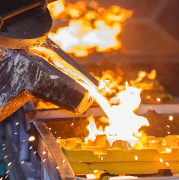
I spent today shadowing the manager of alloy characterization at Carpenter. The alloy characterization group is responsible for analyzing samples prior to production through tests like the tensile test, the creep test, the charpy force test, and electron spectrometer analysis.

The first test I mentioned was a tensile test which essentially stretches out the metal and graphs its elasticity as it is stretched to increasing lengths. I’ve included a graph below detailing what an average graph for such test would look like. The test itself will generally only take 5 minutes to complete prior to the sample breaking. As seen from the graph below, the sample begins with a linear increase in stress which represents the sample reaching its elastic limit. Then, the graph approaches a slope of zero and once it reaches said slope, it is at its upper yield stress. The slope will then proceed to decrease until the sample reaches its lower yield stress. Two very important later points on the graph will be the ultimate stress point which is the absolute maximum of the graph, then the breaking point where the sample will separate into two, and the graph will stop at this point.

The next test used in metal characterization is the creep test, which is similar to the tensile test but takes temperature into consideration. This test has two probe readers to measure strain over time, as, only one could cause the results to be inaccurate.

The graph of a creep test is conceptually simpler than that of a tensile test. It is composed of a primary, secondary, and tertiary stage. The primary stage has a very steep slope as the strain increases rapidly initially. In the secondary stage the strain increases at a slower and constant rate before reaching the tertiary stage where the strain increases rapidly before the sample breaks into two.

The next test used is a Charpy Impact Test in which measures the amount of force (load) a material can withstand. A large cement type block is brought up to a locked position as it clicks into place, then an additionally safety latch is used given the sheer mass of the block, and occasionally even a third safety measure, a long pole, is used to keep it up while cleaning.
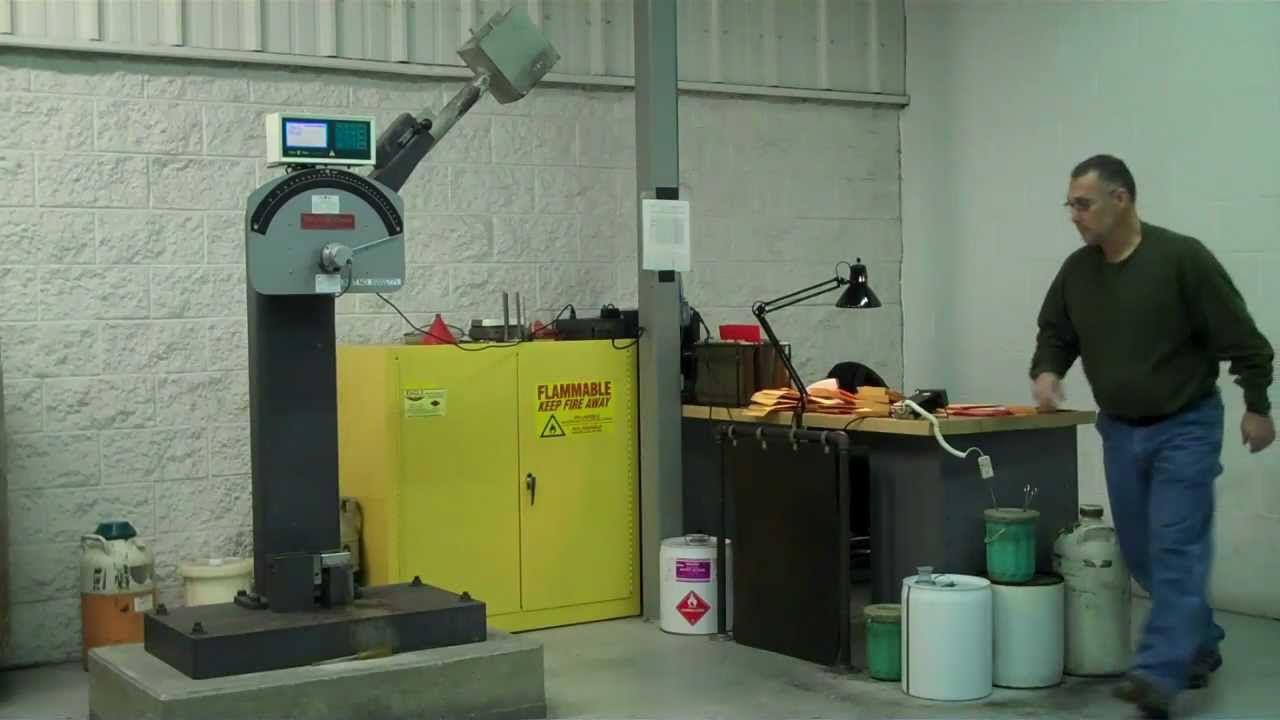
Although this machine calculates the load for you, you could manually calculate the load through forces and equations we learned about in AP Physics 1. You would use the following equation to calculate:
Fg initial = Fg final + Force of Impact
Another very important machine for metal characterization is a Scanning Electron Microscope. This machine can magnify up to 50,000x the naked eye, and is used to identify individual particles or parts of individual particles. Each microscope costs upwards of a million dollars to purchase.
The electron microscope is able to use different crystals with different pheons, which give off certain wavelengths that only react to specific elements, therefore conveying the elemental composition of a material, and allowing materials science engineers to identify what compounds the flaws are in the alloy, and how to best remove those (usually oxide or sulfide).

Although nuclear energy isn’t exactly related to alloy development, I believe we got into a tangent over nuclear power when he explained to me a project he was a part of, creating an alloy to hold nuclear waste. To do so, he had to add a substance into the alloy that would absorb nucleons. Boron is an element capable of absorbing nucleons, but that wasn’t enough so he had to figure out how to add cadmium without the alloy cracking. We then got into talking about the process of nuclear waste and an associate of Bill Gates who has found a new way to reuse nuclear energy source. No one in the United States wants possible radiation in their backyards, so it will be tested in China instead. Similar fears arose in Arizona when the government declared The Yucca Mountain a place to deposit nuclear waste. Even the transportation to that facility worried many and they refused to have nuclear waste running though their backyards on trains.

As aerospace remains a popular market for Carpenter to sell to, I inquired about how testing is done for commercial planes and in space, as they would have to take into account any atmospheric change and temperature. He explained that they have other testing facilities that take that into account, generally the space programs themselves only have the equipment to run tests like that.
Lastly, an essential part to metal characterization is the use of microscopes. The engineers use software to identify particles within alloys and pores which would entail some gases in the alloy, unwanted compounds. Theywere dealing with new routines, ( new programming) due to the fact that their computer system crashed for an entire three months and everything was lost.
Overall I’d say that metal characterization has been of the most interest to me so far.
 Applications of Alloys